


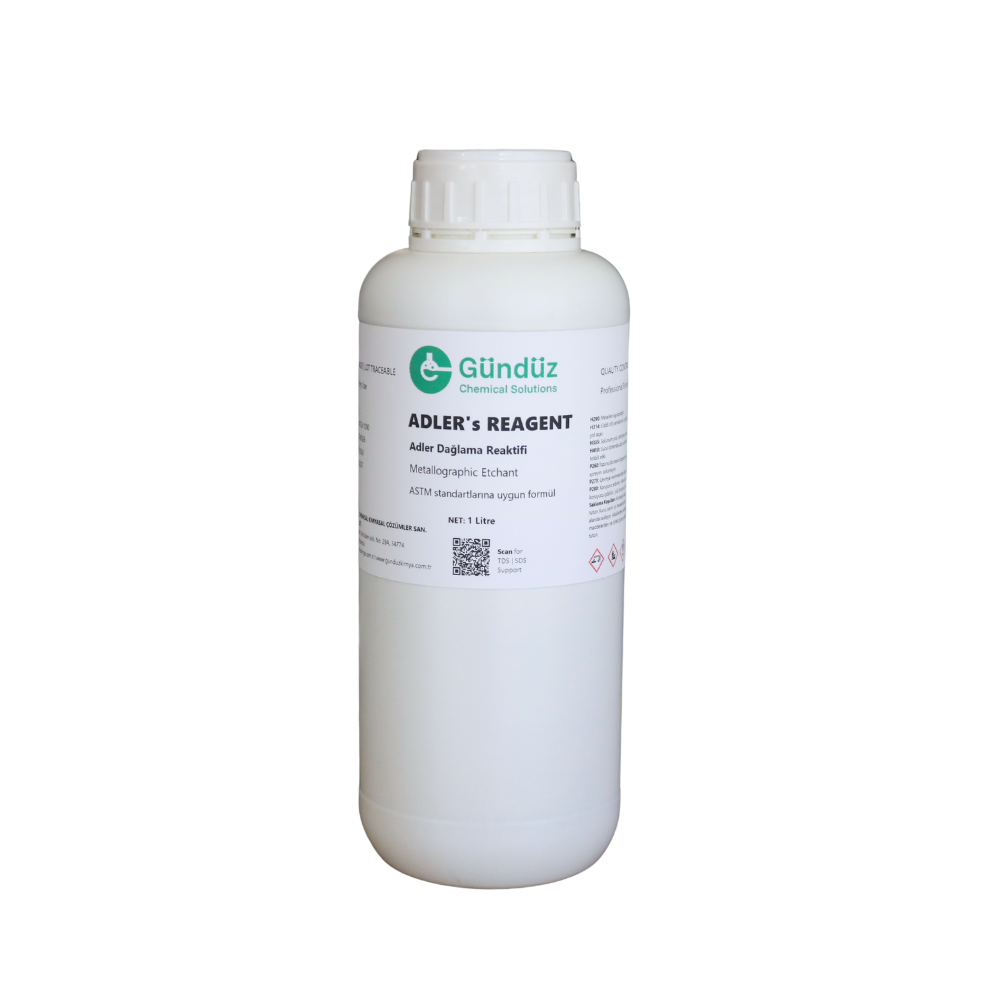


Adler’s Reagent | Metallography | ASTM E407
Adler’s Reagent is widely recognized as one of the most effective and aggressive metallographic etchants available for highly alloyed materials. Standard etchants like Nital are ineffective against the strong, naturally occurring chromium-oxide passive layers found on stainless steels. Adler’s Reagent utilizes a highly reactive combination of heavy metal chlorides and hydrochloric acid to break down this passivity, delivering exceptional microstructural contrast.
Whether your laboratory is examining 300-series austenitic stainless steels, duplex stainless steels, or advanced aerospace superalloys, our Adler’s Reagent ensures deep, repeatable, and easily documentable results essential for rigorous industrial quality assurance.
Certified ASTM E407 Compliance
Accurate phase identification and structural evaluation in high-performance alloys are critical for industries where material failure is not an option. Gündüz Kimya manufactures our Adler’s Reagent in strict adherence to ASTM E407 (Standard Practice for Microetching Metals and Alloys).
Adler’s Reagent Applications & Uses
Our Adler’s Reagent provides exceptional chemical performance for the most demanding high-alloy metallurgical tasks:
-
Stainless Steels: The premier etchant for austenitic, ferritic, martensitic, and duplex stainless steels. Excellently reveals austenite grain boundaries and delta ferrite phases.
-
Nickel and Cobalt Superalloys: Highly effective for etching advanced, heat-resistant alloys such as Inconel, Monel, and Hastelloy used in aerospace and power generation.
-
Dissimilar Metal Welds: Provides extreme clarity when evaluating complex weldments joining different alloy groups, distinctly highlighting the fusion line and Heat Affected Zone (HAZ).
-
Macro-Etching & Defect Analysis: Capable of aggressive macroscopic etching to reveal structural flow lines, porosity, and severe casting defects in high-alloy ingots and forgings.
Adler’s Reagent Flexible Packaging to Suit Institutional Demands
Due to the chemically aggressive and staining nature of heavy metal chlorides, our Adler’s Reagent is packaged securely in chemically inert, industrial-grade containers engineered for maximum laboratory safety and shelf-life:
-
250 ml Bottle: Ideal for specialized alloy research, failure analysis laboratories, or low-volume targeted testing.
-
500 ml Bottle: The standard configuration for industrial laboratories managing regular stainless steel and superalloy quality control workflows.
-
1 Liter (1000 ml) Bottle: The highly efficient and economical choice for high-capacity foundries, aerospace manufacturers, and large-scale materials testing facilities.
Why Choose Gündüz Kimya’s Adler’s Reagent?
-
Exceptional Purity: Compounded utilizing strictly analytical-grade acids, premium metal chloride salts, and highly purified distilled water to prevent sample contamination.
-
Ready-to-Use Safety: Professionally pre-mixed and stabilized. This eliminates the messy, highly corrosive, and hazardous process of mixing concentrated hydrochloric acid with dry chemical powders in your laboratory.
-
Unwavering Consistency: Rigorous batch-control guarantees identical etching performance across every order, ensuring the absolute reliability of your long-term metallurgical data.
-
Specialized Storage: Packaged in high-density, acid-resistant containers designed specifically to safely house aggressive chloride solutions without degradation.
Technical Specifications
| Feature | Specification |
| Product Name | Adler’s Reagent (Metallographic Etchant) |
| Standard Compliance | ASTM E407 |
| Active Ingredients | Distilled Water, Hydrochloric Acid, Ferric Chloride, Cupric Ammonium Chloride |
| Appearance | Dark brownish liquid |
| Available Volumes | 250 ml, 500 ml, 1 Liter |
| Application Method | Swabbing or Immersion (typically a few seconds to 1 minute; monitor closely) |
| Grade | Analytical / Laboratory Grade |
| Manufacturer | Gündüz Kimya |
Safety & Handling Warning:
Adler’s Reagent is a highly corrosive and toxic chemical mixture containing strong acids and heavy metal salts. It will cause severe skin burns, eye damage, and will aggressively stain skin, clothing, and laboratory surfaces. Extreme laboratory safety precautions are absolutely mandatory. Always use complete Personal Protective Equipment (PPE), including heavy-duty acid-resistant gloves, a face shield over safety goggles, and a heavy protective lab coat. Use strictly under a certified laboratory fume hood. Store in a dedicated corrosive safety cabinet away from alkaline materials and active metals. Please consult the comprehensive Safety Data Sheet (SDS) provided by Gündüz Kimya prior to use.