

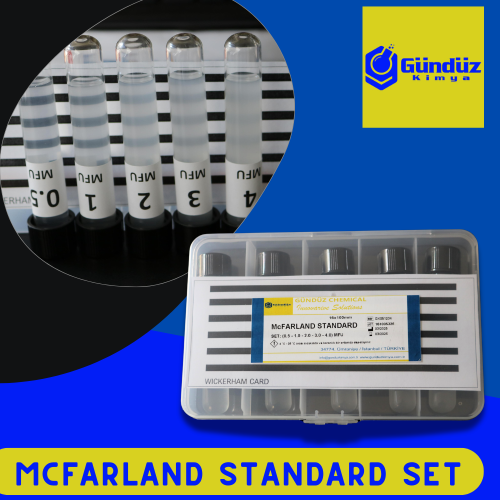



| PRODUCT NAME | MC FARLAND STANDARD SET |
| Product Code | GK051234.0100 |
| BOX CONTENT | QUANTITIY |
| Mc Farland Standart Solüsyonu – 0.5 | 16x100mm screw cap test tube x 1 |
| Mc Farland Standart Solüsyonu – 1.0 | 16x100mm screw cap test tube x 1 |
| Mc Farland Standart Solüsyonu – 2.0 | 16x100mm screw cap test tube x 1 |
| Mc Farland Standart Solüsyonu – 3.0 | 16x100mm screw cap test tube x 1 |
| Mc Farland Standart Solüsyonu – 4.0 | 16x100mm screw cap test tube x 1 |
SET CONTENT: 0.5 – 1.0 – 2.0 – 3.0 – 4.0
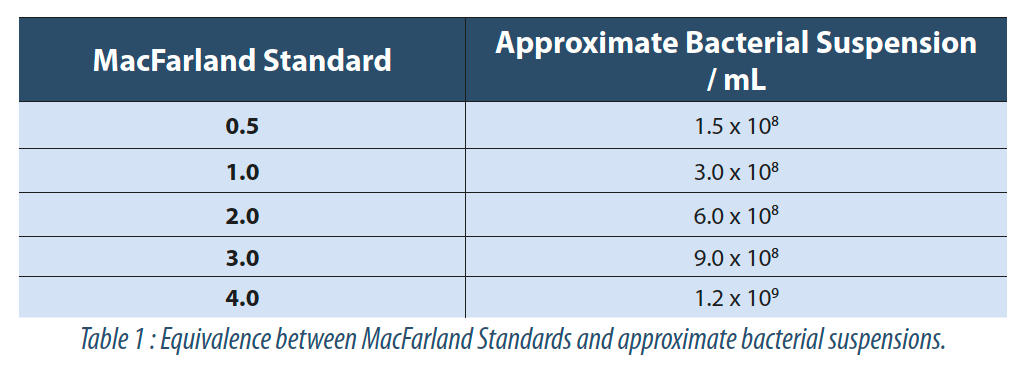
The McFarland Standard Set is a reference system used in microbiology laboratories to standardize the turbidity of bacterial suspensions. These standards contain barium sulfate (BaSO₄) or latex particles to create solutions with specific optical densities (OD), allowing researchers to estimate bacterial concentrations.
Procedures
1. Mix McFarland Standard on a vortex mixture prior to examination. Ensure that the McFarland Standard is aliquoted into a tube that is the same size and diameter as the tube used to prepare the test suspension.
2. Prepare a test suspension by obtaining a fresh, pure culture of the test organism and inoculating a suitable broth.
3. In the presence of good lighting, visually compare the turbidity of test suspension with that of the McFarland standard by comparing the clarity of the lines on the a Wickerham card.
4. If the test suspension is too light, inoculate with additional organisms or incubate tube until turbidity matches that of the standard. If dilution is necessary, use a sterile pipette and add sufficient broth or saline to obtain a turbidity that matches that of the standard.
These standards are commonly used for antibiotic susceptibility testing (e.g., Kirby-Bauer disk diffusion method) and for adjusting microbial inoculum density in various experiments.
Applications of McFarland Standards
McFarland standards are widely used in microbiology for:
a) Antibiotic Susceptibility Testing (AST)
-
Used to standardize bacterial inoculum for Kirby-Bauer disk diffusion, broth dilution, and E-test methods.
-
Ensures reproducibility of antimicrobial testing results across laboratories.
b) Microbial Growth Standardization
-
Helps maintain consistent bacterial concentrations in biochemical tests, microbial fermentation, and industrial microbiology.
c) Identification of Bacteria
-
Used in automated identification systems (e.g., VITEK, Phoenix) to standardize bacterial suspensions.
d) Minimum Inhibitory Concentration (MIC) Testing
-
Used in broth microdilution assays to assess bacterial resistance and determine effective antibiotic concentrations.
Precautions
• McFarland Standards are sensitive to air and light therefore ensure that the tubes areclosed tightly at all times and kept in the dark.
• The level of McFarland standards should be checked occasionally to ensure that evaporation has not occurred. Discard if any volume is lost.
• The McFarland Standards should be vigorously agitated on a mechanical vortex before each use and inspected for a uniform turbid appearance. If large particles appear or if clumping is apparent discard the
standard.
• Actual numbers of viable bacteria present in an adjusted suspension depends on the size, viability, and clumping of the particular bacterium used.
Step-by-Step Preparation of Bacterial Suspension
Step 1: Prepare a Fresh Bacterial Culture
-
Take a pure bacterial colony from an agar plate.
-
The culture should be 18–24 hours old to ensure optimal bacterial viability.
Step 2: Select the Suspension Medium
-
Use sterile saline (0.85% NaCl) or sterile nutrient broth to suspend the bacteria.
-
Avoid distilled water as it can cause cell lysis.
Step 3: Adjust the Bacterial Density
-
Transfer 4–5 bacterial colonies into a tube containing sterile saline or broth.
-
Mix well using a vortex mixer or by gentle pipetting.
-
Compare the turbidity of the bacterial suspension to the McFarland 0.5 standard by:
-
Holding both tubes against a white background with black lines for visual comparison.
-
Using a spectrophotometer at 600 nm (0.5 McFarland should give 0.08–0.10 absorbance).
-
Step 4: Adjust if Necessary
-
Too turbid (high density)? → Dilute with more saline or broth.
-
Too clear (low density)? → Add more bacteria and mix again.
Applications of McFarland Suspensions
✅ Antibiotic Susceptibility Testing (AST) – Ensures standardized bacterial inoculum.
✅ Microbial Identification – Used in automated systems like VITEK & Phoenix.
✅ Biochemical Testing – For metabolic and enzyme activity studies.
Storage and Shelf Life
Our McFarland Standards should be stored in an upright position at 4°C to 25°C and protected from light. Under these conditions they have a shelf life of 12 months from the date of manufacture.