



Nital Solution %1 | Nital Etchant | ASTM E407
The Nital Solution %1 is one of the most widely utilized and highly trusted metallographic etchants in the industrial sector. Engineered for absolute precision, our 1% concentration provides a gentle, highly controlled etching rate. This makes it the premier choice for sensitive microscopic examinations, preventing the over-etching and obscuration of delicate microstructural features often caused by higher-concentration acids.
Whether your institution is conducting routine quality control, complex failure analysis, or advanced academic research, our Nital 1% ensures consistent, repeatable, and easily documentable results.
Certified ASTM E407 Compliance
Quality and standardization are at the core of reliable metallurgical analysis. Our 1% Nital Solution is formulated to fully comply with ASTM E407 (Standard Practice for Microetching Metals and Alloys).
By utilizing an ASTM E407-compliant etchant, laboratories guarantee that their microstructural evaluations, grain size measurements, and phase identifications meet international testing and documentation requirements.
Nital Solution %1 Applications & Uses
Optimized for high-performance metallurgical tasks, our 1% Nital Etchant is strictly formulated for:
-
Carbon Steels & Low-Alloy Steels: Exceptional at revealing ferrite grain boundaries and highlighting pearlite, bainite, and martensite phases.
-
Cast Irons: Highly effective in distinguishing the structural differences between ferrite and pearlite in grey, nodular, and malleable cast irons.
-
Weld Examinations: Ideal for both macroscopic and microscopic examination of weld cross-sections to precisely define the Heat Affected Zone (HAZ).
-
Surface Hardening Analysis: Perfect for evaluating case depth and structural integrity in carburized, carbonitrided, or induction-hardened components.
Nital Solution %1 Flexible Packaging to Suit Institutional Demands
To ensure maximum chemical stability, safety, and operational convenience for laboratories of all scales, our Nital Solution 1% is available in three secure, chemically resistant packaging configurations:
-
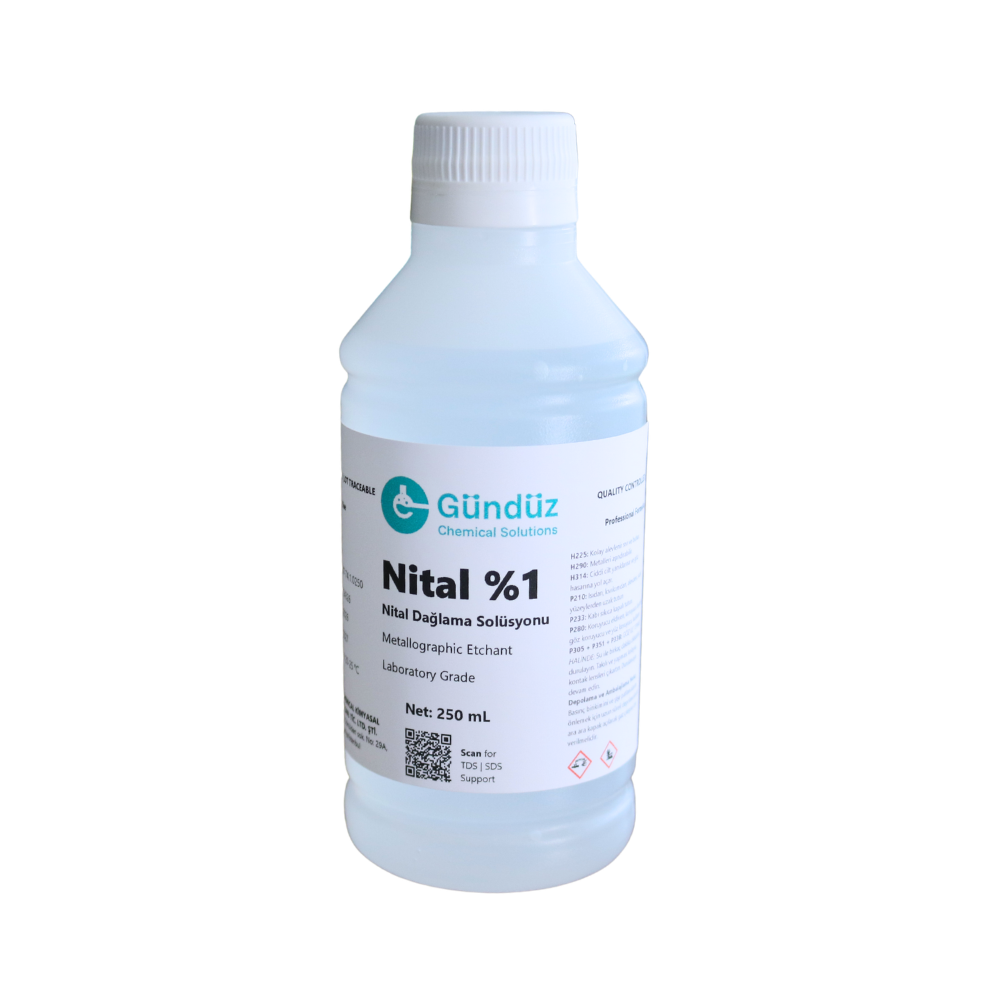
250 ml Bottle: Designed for low-volume testing, academic laboratories, or field inspection kits.
-
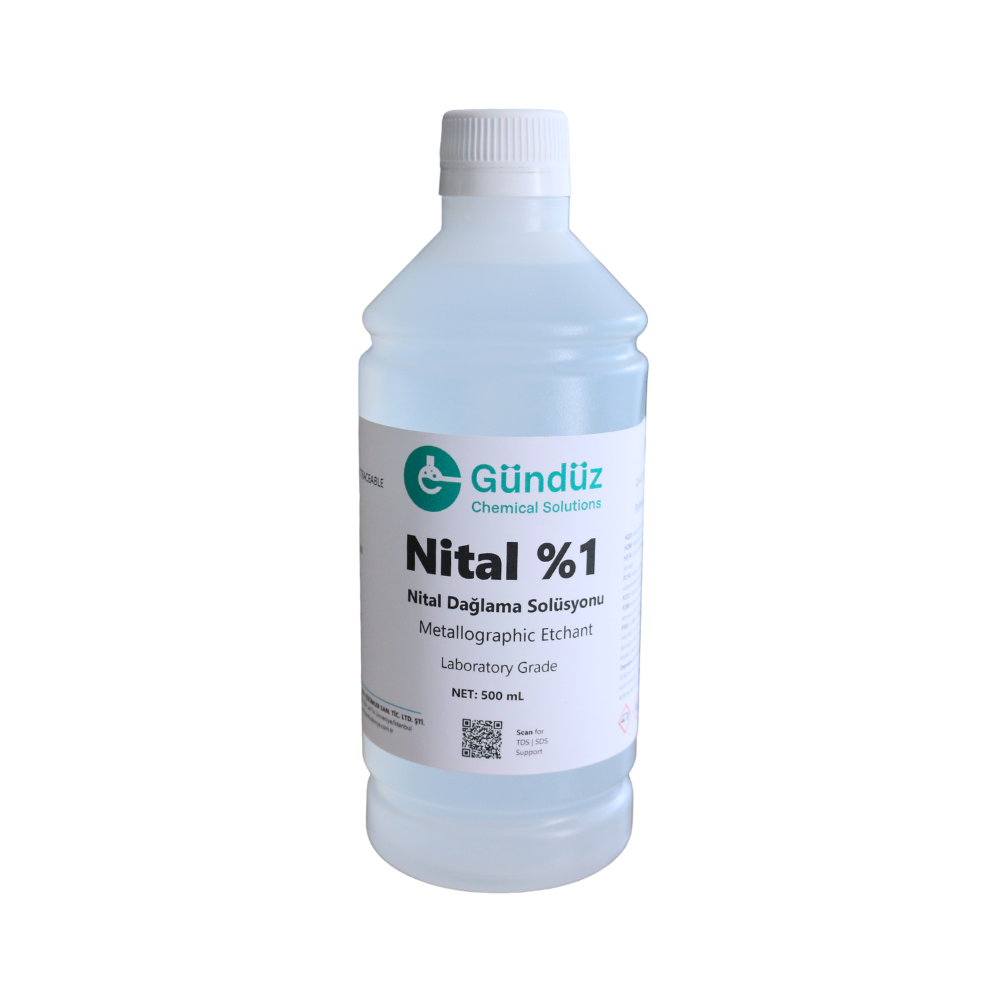
500 ml Bottle: The industry standard for regular laboratory operations and daily quality inspections.
-
1 Liter (1000 ml) Bottle: The most economical and efficient option for high-volume industrial laboratories and continuous manufacturing environments.
Why Choose Gündüz Kimya’s Nital Solution %1 ?
-
Exceptional Purity: Compounded using exclusively analytical-grade reagents (Nitric Acid and Ethanol/Methanol) to strictly prevent sample contamination.
-
Ready-to-Use Formulation: Professionally pre-mixed to exact 1% volumetric specifications, optimizing laboratory workflow and minimizing the hazards associated with handling concentrated corrosive acids.
-
Consistent Etch Rates: Guaranteed batch-to-batch consistency for reliable, standardized microstructure reproduction across all your testing cycles.
-
Extended Shelf Life: Securely packaged in specialized, airtight, opaque containers to prevent degradation from UV light exposure and oxidation.
Technical Specifications
| Feature | Specification |
| Product Name | Nital Solution 1% (Metallographic Etchant) |
| Standard Compliance | ASTM E407 (Standard Practice for Microetching) |
| Active Ingredients | Nitric Acid & Industrial Alcohol |
| Concentration | 1% Nitric Acid |
| Appearance | Clear, colorless liquid |
| Available Volumes | 250 ml, 500 ml, 1 Liter |
| Application Method | Swabbing or Immersion (typically 5 to 60 seconds) |
| Grade | Analytical / Laboratory Grade |
| Manufacturer | Gündüz Kimya |
Safety & Handling Information: Nital solution is a flammable and corrosive chemical mixture. Always use appropriate Personal Protective Equipment (PPE), including chemical-resistant gloves, safety goggles, and a lab coat. Use only in a well-ventilated area or under a fume hood. Store in a cool, dry, and well-ventilated dedicated chemical safety cabinet away from direct sunlight and incompatible materials. Please refer to the comprehensive Safety Data Sheet (SDS) provided by Gündüz Kimya for detailed safety protocols.